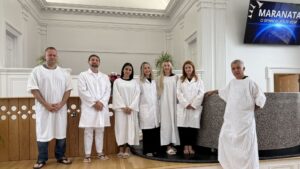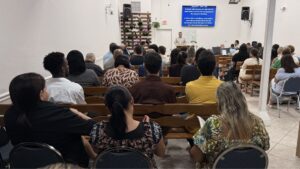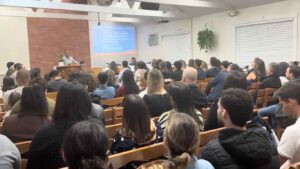
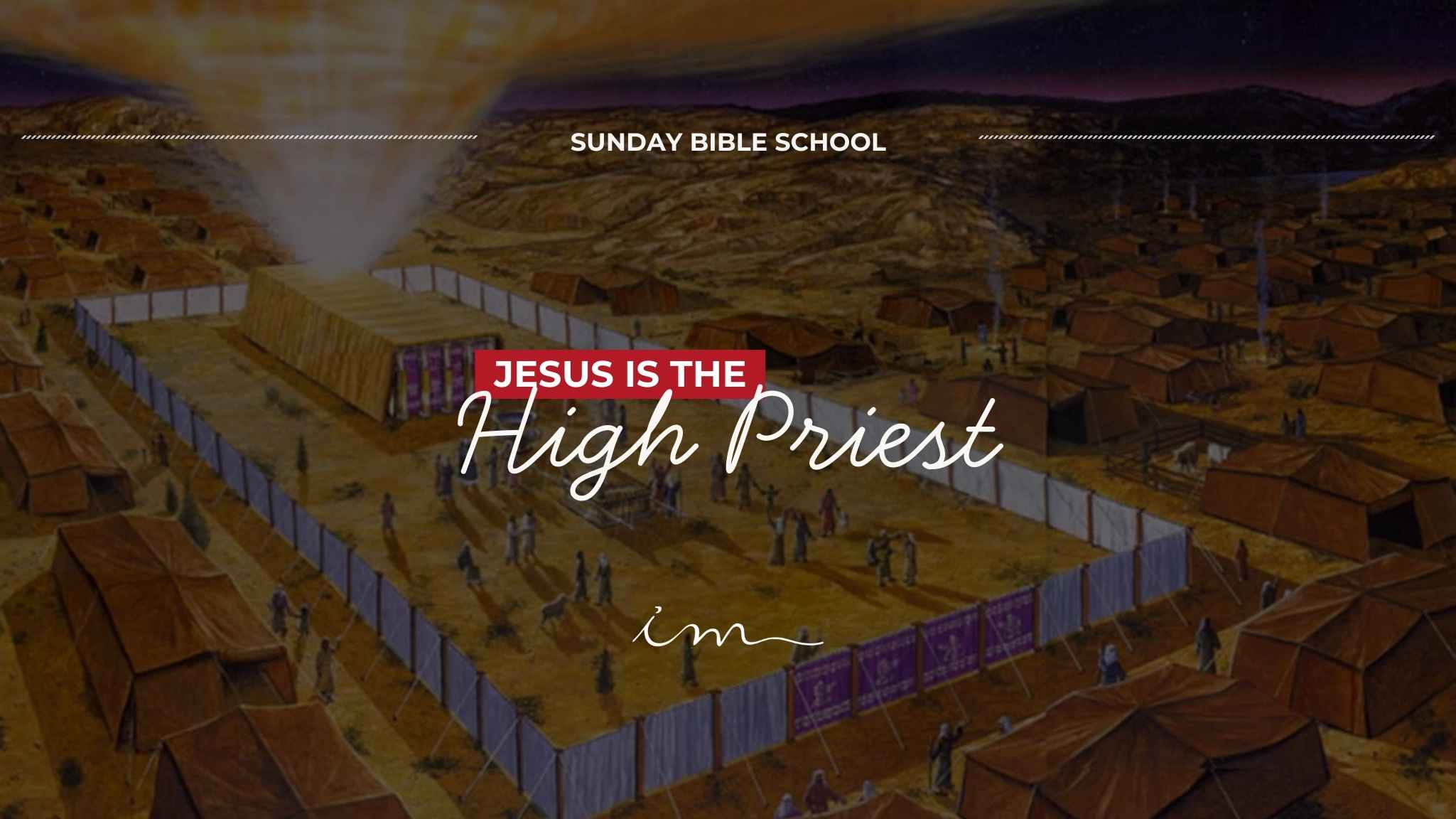
The Maranatha Christian Church Sunday Bible School on January 25th, 2026, was held live from Rádio e TV Maanaim, in Vila Velha, Espírito Santo, Brazil, with the participation of Pastors Alexandre Gueiros, Gilson Sousa, and Gerson Beluci.
Pastor Gerson Beluci emphasized that God is just, holy, and true, and He requires holiness from everyone who approaches Him. He referred to Leviticus 19:2, which states, “Speak to all the congregation of the children of Israel and say to them: ‘You shall be holy, for I the Lord your God am holy.’”
The book of Leviticus shows our position before God’s holiness. The apostle Peter emphasizes this as a command from God: “[…] Be holy, for I am holy.” — 1 Peter 1:16
But this holy God is also a God of love, grace, and mercy. He does not look at our weaknesses or sins, yet He provided a way to meet His own requirements by sending His Son. Jesus lived a holy life and offered Himself on the cross of Calvary for sinners. As Paul says:
“This is a faithful saying and worthy of all acceptance, that Christ Jesus came into the world to save sinners, of whom I am chief.” — 1 Timothy 1:15
The central theme of the Tabernacle is the Lord Jesus, revealed in its parts, furnishings, and rituals. Jesus sanctifies His Church through the Holy Spirit, according to the plan of salvation established from the foundation of the world by His blood.
“Elect according to the foreknowledge of God the Father, in sanctification of the Spirit, for obedience and sprinkling of the blood of Jesus Christ: Grace to you and peace be multiplied.” — 1 Peter 1:2
Five Important Aspects in the Tabernacle
- The Fine Linen Curtain — Symbolizes holiness and separation from the desert; it represents separation from sin and fellowship with God.
- The Entrance Gate — Represents the invitation to salvation. Jesus is the Door. Each sinner must enter individually, leaving the desert life behind to enjoy fellowship in the Tabernacle, that is, fellowship in the Church.
“I am the door. If anyone enters by Me, he will be saved, and will go in and out and find pasture.” — John 10:9 - The Bronze Altar — The altar of burnt offerings demonstrates God’s holiness and the judgment on sin, fulfilled in the gift of eternal life through Jesus Christ.
“[…] who became for us wisdom from God—and righteousness and sanctification and redemption—.” — 1 Corinthians 1:30 - The Bronze Laver — Shows the priests’ daily purification through the Word of God. Like a mirror, the Word reveals what must be changed in our lives. Jesus gave Himself to sanctify and cleanse the Church.
“Husbands, love your wives, just as Christ also loved the church and gave Himself for her, that He might sanctify and cleanse her with the washing of water by the word.” — Ephesians 5:25-27 - The Consecration of the Priests — The priests were purified with blood and anointed with oil. Blood on the right ear teaches attentiveness to God’s voice, blood on the right hand prepares for service, and blood on the right foot guides the walk in the Spirit.
“Then Moses took some of the anointing oil and some of the blood which was on the altar, and sprinkled it on Aaron, on his garments, on his sons, and on the garments of his sons with him.” — Leviticus 8:30
Under the New Covenant, Jesus is the High Priest, and by faith we become children of God, members of the family of the High Priest, called to exercise the priesthood of the New Covenant.
“and has made us kings and priests to His God and Father, to Him be glory and dominion forever and ever. Amen.” — Revelation 1:6
As priests, we may continually offer the sacrifice of praise and intercede for others:
“Therefore by Him let us continually offer the sacrifice of praise to God, that is, the fruit of our lips, giving thanks to His name.” — Hebrews 13:15
The Priestly Garments
Pastor Alexandre Gueiros explained the priestly garments required for ministry. These garments symbolize salvation and righteousness, representing the believer’s testimony and conduct before God and men.
Isaiah describes:
“I will greatly rejoice in the Lord, my soul shall be joyful in my God; For He has clothed me with the garments of salvation, He has covered me with the robe of righteousness.” — Isaiah 61:10
The Holy Spirit is the divine Craftsman who enables sanctification in our lives, producing the fruit of the Spirit: love, joy, peace, patience, kindness, goodness, and faithfulness. The anointing oil, composed of myrrh, cinnamon, calamus, and olive oil, represents Christ’s obedience, suffering, fragrance, and the Spirit’s enabling power for service.
The anointing applies to all areas of the Church. True worship, prayer, and ministry are acceptable only through the operation of the Holy Spirit, never through human effort alone.
“I am the vine, you are the branches. He who abides in Me, and I in him, bears much fruit; for without Me you can do nothing.” — John 15:5
Thus, in every hymn, prayer, and service, the anointing oil and the sprinkling of the blood of Jesus work together to confirm our sanctification in the New Covenant.
To Continue the Study
If you would like to go further in this study, click here to access the full Sunday Bible School Bulletin.
Watch the Maranatha Christian Church Sunday Bible School broadcast:
Click here to access all previous Sunday Bible School Bulletins.